



Next-generation drones, also known as uncrewed aerial vehicles (UAVs), demand high-performance RF components to meet the dynamic requirements in autonomy, range, and communications. As commercial, industrial, and defense-grade UAVs expand into more complex roles, RF technology has become the backbone of how drones sense, decide, coordinate, and stay connected.
RF systems have evolved from supporting simple RC control links into the command center governing every major subsystem in modern UAVs. Today’s platforms incorporate wideband, multi-band, multi-protocol radios that must intelligently operate in crowded, contested, and regulated spectrum. Successful UAV designs require:
- Resilient, low-latency communications
- Spectrally aware operation under changing conditions
- High-volume, low-error data transfer for autonomy
- Robust protection against interference, spoofing, and jamming
Drone Types and Their RF Demands
Drones vary widely in design, capabilities, and RF requirements, with each type optimized for specific missions.
Fixed Wing Drones
Resembling traditional airplanes, fixed-wing UAVs provide efficient long-distance flight. They are commonly used for aerial mapping, agricultural spraying, and defense surveillance. Fixed-wing UAVs require long-range communications, robust telemetry, and interference-resistant GNSS for extended missions.
Multi-Rotor Drones
Quadcopters, hexacopters, and octocopters offer vertical takeoff, precise maneuverability, and stable flight. Their densely packed motors generate significant RF noise, necessitating careful filtering and GNSS protection. Applications include aerial photography, inspection, and surveillance.
Single-Rotor Drones
These helicopter-like drones have a single main rotor and tail rotor, allowing efficient lift for heavier payloads. They are less common due to higher cost and complex design. RF systems in single-rotor drones must prioritize telemetry, long-range C2 links, and navigation redundancy to support stable flight.
Hybrid VTOL Drones
Hybrid VTOL platforms combine vertical takeoff and landing with efficient forward flight, making them suitable for cargo delivery, mapping, and surveillance. Their variable flight modes require multi-band radios, adaptive antennas, and resilient navigation systems.
Common Applications Across Drone Types
- Photography and Videography: High-resolution imaging, autopilot modes, low-latency video links, and GNSS-based stabilization
- Defense and ISR: Secure C2 links, anti-jam communications, long-range telemetry, and beamformed directional antennas
- Agriculture: Crop monitoring, precision spraying, and telemetry over wide fields with interference mitigation
- Emergency Response: Rapid deployment for disaster assessment, medical supply delivery, and communication relay, requiring robust RF links and resilient navigation
System-Level RF Architecture of a Drone
A drone’s system-level RF infrastructure is shaped by its mission profile and technical requirements, including:
- Flight Time: Longer battery life is required for extended flight times
- Payload Capacity: Ability to carry sensors and additional equipment
- Flight Range: Maximum distance the drone can operate from the controller
- Cost and Budget: Trade-offs between technical performance and expense
Balancing SWaP-C constraints with the need for resilient communication ensures that systems can withstand interference, avoid receiver overload, and remain agile across congested spectrum. Today’s designs demand strong filtering, limiters, GNSS anti-spoofing protection, and safeguards against jamming. For platforms that need long-range or contested-environment connectivity, satellite backhaul systems such as Starlink add another layer of reliability by providing difficult-to-jam links that continue to evolve in response to operational restrictions.
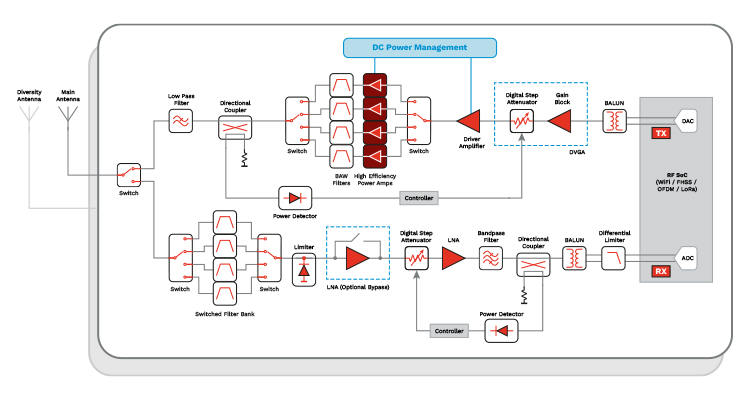
RF Subsystems Overview
Directional Communications and Long-Range Links
Efficient long-range communication is a fundamental drone capability, but achieving it requires navigating a wide range of engineering challenges. Maintaining reliable connectivity across vast distances, through complex terrain, and in difficult weather conditions demands expert consideration to link budget, antenna alignment, and mitigation of multi-path interference. Sub-GHz, L, S, and C-band systems are widely deployed to support mission continuity with modulation schemes and low-SWaP operation even when power constraints limit available transmission.
In fleet environments, cellular or mesh backhaul not only enables cloud connectivity, distributed autonomy, and coordinated missions, but it also introduces tighter dependencies on RF performance and power consumption. The communication link increasingly functions as both a data-transport and authentication layer. providing critical intelligence that enhances operational awareness and system reliability.
Command and Control (C2) Links
Power Amplifiers
In UAV systems, power amplifiers (PAs) boost RF transmit signals to levels required for reliable over-the-air communication in drone command, control, telemetry, and video links. High output power, efficiency, gain, and thermal performance are critical for maximizing link range while preserving battery life in SWaP-constrained UAV platforms.
The CMX90A007 from CML Micro is high-frequency, high-bandwidth power amplifier that delivers efficient power performance to conserve battery resources. With strong gain supporting long-range communication links and small, ruggedized packaging for lightweight designs, this Sub-GHz power amplifier is ideally suited to unmanned aircraft system (UAS) applications.
CMX90A007 Key Specifications
- Frequency Range: 136 – 1000MHz
- Signal Gain: 26dB
- Power Output: 2W
- Supply Voltage: 7.4V
- Size: 4 x 4mm
The QPA0106 from Qorvo delivers the high output power, linear gain, and efficiency required for long-range, multi-band drone communication with a strong link margin. Its GaN device architecture provides exceptional robustness for thermal load, making it optimally suited for SWaP-constrained designs.
QPA0106 Key Specifications:
- Frequency Range: 1 – 6GHz
- Gain: 31dB
- Output Power: 18W
- Power Added Efficiency (PAE): >40%
- Size: 7 x 7mm
Gain Block and Driver Amplifiers
Gain block and driver amplifiers provide stable broadband gain to condition signals and drive higher-power amplification stages within drone RF transmit chains. Key performance factors include linearity, flat gain across wide frequency ranges, and low power consumption to maintain signal integrity and spectral efficiency in multi-band UAV radios
Guerilla RF gain block and driver amplifier solutions are ideal for UAV designs. The GRF5112 supports multi-band operation with a single PA. Delivering high-performance linearity for high-quality transmission, it operates efficiently with low voltage and current consumption. Additionally, the GRF5112 serves as a highly effective driver amplifier for higher-power stages.
GRF5112 Key Specifications:
- Frequency Range: 0.03 – 3GHz
- Gain: 17dB
- Saturated Power: 1.5W
- Power Supply: 5V @ 212mA
The GRF2013 is another Guerilla RF amplifier solution optimized for next-generation UAV systems. Its linear broadband gain ensures efficient and stable command-and-control links while minimizing adjacent-channel interference. Its flexible supply bias further enhances power efficiency and system reliability.
GRF2013 Key Specifications:
- Frequency Range: 0.01 – 9GHz
- Gain: 18.5dB
- Supply Voltage & Current: 2.7 to 8V @ 15 to 100mA
- Size: 1.5 x 1.5mm
The Qorvo QPA9126 gain block provides stable, high-linearity performance across temperature and supply for robust airborne operation. Its flat gain over a broad frequency range supports spectral efficient signals to ensure reliable RF links in dynamic environments.
QPA9126 Key Specifications:
- Frequency Range: 1 – 6GHz
- Gain: 16dB
- P1dB: 20dBm
- IP3: 35dBm
- Size: 2 x 2mm
Gain block and amplifier solutions from Marki Microwave offer unique advantages in drone designs. The ADM-8622PSM is a high-linearity gain block that ensures clean, distortion-free transmission across a wide range of communication bands and waveforms in modern drones. Its compact broadband design and minimal SWaP footprint make it ideal for extending operational range and maximizing platform efficiency.
ADM-8622PSM Key Specifications:
- Frequency Range: 0 – 10GHz
- Gain: 15.5dB
- Output Power (P1dB): 13.5dBm
- IP3: 26dBm
- Power Supply: 3.3V @ 40mA
The Marki Microwave ADM-0012-5931SM distributed driver amplifier is optimized for local oscillator (LO) and mixer driver applications, delivering strong broadband gain and excellent linearity across a broad frequency range. Its flexible bias options allow for maximum efficiency.
ADM-0012-5931SM Key Specifications:
- Frequency range: 0 – 12GHz
- Gain: 11.5dB
- P1dB: 16dBm
- Size: 3 x 3mm
Low Noise Amplifiers (LNAs)
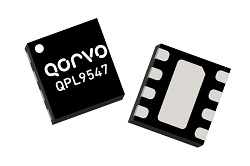
Ultra-low-noise performance significantly improves weak-signal sensitivity, enabling reliable long-range communication links in UAV systems. High linearity helps maintain clean signal reception even in congested RF environments where strong adjacent signals may be present. Compact packaging further supports SWaP requirements of drone platforms, helping maximize battery efficiency and overall system endurance.
 |  |  |
| GRF4014 | ||
· Freq: 0.1 – 6 GHz · Gain: 19.3dB · Noise figure: 0.3dB · P1dB: 22.7dBm · Size: 2 x 2mm | · Freq: 0.1 – 6 GHz · Gain: 16.5dB · Noise figure: 0.8 dB · P1dB: 24dBm · Size: 1.5 x 1.5mm | · Freq: 0 – 20 GHz · Gain: 17.5dB · Noise figure: 1.8 dB · P1dB: 20dBm · Size: 3 x 3mm |
Telemetry/Video Links
Telemetry and video links enable drones to transmit real-time flight data and high-resolution video streams back to operators or control systems. These high-throughput RF links require high linearity, wide bandwidth, and efficient power amplification to support low-latency transmission while maintaining reliable connectivity over long distances.
CML Micro’s high-power linear amplifiers for high data-rate links maximizes efficiency for conserving battery resources and thermal load. The MMG-446040 provides strong gain performance for link robustness and reliability.
MMG-446040 Key Specifications:
- Frequency range: 4.4 – 6.0GHz
- Gain: 27dB
- Output Power; 10W
- Power Added Efficiency (PAE): 40%
- Size 5 x 5mm
High-Q MLC capacitors from Knowles enhance drone performance by utilizing ultra-low resistance to preserve signal strength and reduce heat, effectively extending both battery life and reliable link range. Their superior thermal stability and precision filtering eliminate video interference and frequency drift, ensuring a crystal-clear feed even as components heat up during flight. By maintaining low phase noise in telemetry oscillators, these capacitors also guarantee that critical data like GPS coordinates remain accurate and free from corruption.
Knowles offers a range of high Q lumped element, ceramic resonator, cavity, and thin film microstrip LPFs and BPFs that are well suited for drone RF transceivers requiring low loss, compact size, and excellent out of band rejection. Their filter technology extends to compact switched filter bank modules that save critical board space. Their thin film microstrip and ceramic coaxial resonator filters, in particular, deliver stable performance which is ideal for common drone command, control, and telemetry bands. For example, the L050XF9S is a DC-4.8 GHz low pass filter utilizing high dielectric ceramic materials to deliver low insertion loss and excellent high side rejection.
Lowpass and Bandpass Filters
Lowpass and bandpass filters shape RF signals by allowing desired frequencies to pass while rejecting unwanted harmonics and interference. In drones, high rejection, low insertion loss, and compact size are essential for maintaining clean signals in dense RF environments and minimizing interference from onboard electronics such as motors and switching regulators.
With high rejection and excellent pass band performance, Marki Microwave lowpass and bandpass filters utilize advanced glass substrate technology and GaAs MMICs for small, lightweight filter construction and precision performance critical for drones.
MFLP-00044GSM2 Key Specifications:
The MFLP-00044GSM2 is a compact low-pass filter with a glass substrate, featuring:
- F1dBc and F3dBc of 2.61 and 2.96GHz
- Return Loss: 24dB
- Size: 4.27 x 4.0mm
MFBP-00001PSM Key Specifications:
The MFBP-00001PSM is a GaAs MMIC bandpass filter, featuring:
- Center frequency of 5.4GHz
- 3dB bandwidth of 1.8GHz
- Return Loss: 23dB
- Size: 4 x 4mm
Satellite Links
Satellite communication links enable beyond-visual-line-of-sight (BVLOS) drone operation by providing global connectivity when terrestrial links are unavailable. High-frequency RF components for Ku- and Ka-band systems must deliver strong linear output power, wide bandwidth, and efficient thermal performance to maintain reliable uplink and downlink communications.
CML Micro’s Ku and Ka band amplifiers featuring high linear output power with strong wideband gain necessary for drones requiring beyond visual line of sight and efficient high frequency uplinks.
Ku-band
Ka-band
Mixers
Mixers are frequency-conversion devices that translate signals between RF, intermediate frequency (IF), and local oscillator (LO) domains within drone radios and radar systems. Low conversion loss, strong isolation, and wide operating bandwidth help preserve signal quality while minimizing the need for additional amplification stages.
The Marki Microwave MM1-0832LSM mixer supports X-band through Ka-band operation and maintains performance across a wide high-frequency span. With low conversion loss, it reduces need for additional LNAs or PAs reduce power consumption and weight. The MM1-0832LSM’s small MMIC package provides thermal stability in size-constrained designs.
MM1-0832LSM Key Specifications:
- RF Frequency Range: 8 – 32GHz
- LO Frequency Range: 8 – 30GHz
- IF Frequency Range: 0 – 12GHz
- Conversion Loss: 7.5dB
- LO-RF Isolation: 36dB
The Thermopad® Series from Smiths Interconnect provides efficient heat transfer from high-power RF modules used in satellite connected drones, improving reliability during extended missions. The series supports compact, lightweight SWaP optimized designs and is suitable for operating across wide microwave frequency ranges – critical for maintaining signal integrity in command and control and high-throughput data links.
WTVA Series Specifications:
- Frequency Range: DC – 20GHz
- Max Input Power: 200mW
- Size: 1.52 x 1.91mm
KTVA Series Specifications:
- Frequency Range: 16 – 36GHz
- Max Input Power: 200mW
- Size: 3.05 x 1.65mm
Filters
RF filters play a critical role in protecting drone receivers and transmitters by suppressing out-of-band signals and preventing interference from nearby transmitters or onboard electronics. Low insertion loss, high rejection, and stable performance across temperature are key for maintaining reliable communication and navigation links.
Smiths Interconnect’s Planar X Series provides compact, high-performance RF filtering for satellite communication links used in advanced drone platforms. The lightweight planar design supports SWaP-optimized payloads while delivering low insertion loss and excellent out-of-band rejection, helping maintain signal integrity in X-, Ku-, and Ka-band SATCOM and high-throughput data links. Surface-mount construction enables compact RF subsystem integration while robust materials support operation in harsh environments typical of aerospace and defense applications.
Beamforming for Directional Communication Phased Array Radar
Enabled by advances in active electronically scanned array (AESA) technology, beamforming is a signal-processing technique that uses multiple antennas arrange in an array to transmit or receive signals in specific electronically steerable directions, without mechanically moving the antenna.
In modern UAV design, it’s essential that beamforming ensures long-range, high-bandwidth communication that’s resilient to interference and maintains consistent performance throughout UAV mobility. Beamforming improves link reliability, increases range, and enhances resistance to interference or jamming in dynamic operating environments.
Phased Array Solutions
Axiro Semiconductor Inc. offers a line of advanced communications solutions that drive performance, reliability, and innovation across UAV designs. Their line of active beamforming ICs are compact, cost-effective solutions ideal for phased array systems.
X-Band | Ku/CDL | Tx part | Rx part |
| F6415 | F6413 | F6522 | F6222 |
Operating in the Ka-Band, Qorvo’s AWMF-0198 beamformer enables high data rate transmission for long-range autonomy while supporting HD video and sensor information. Its full polarization flexibility enhances link resilience throughout mission duration. The AWMF-0198 also features integrated gain compensation over temperature, a key advantage for UAV systems that experience large altitude and temperature shifts.
AWMF-0198 Key Specifications:
- Frequency Range: 27.5 – 31GHz
- Polarization: RHCP, LHCP, Linear
- Operating Voltage: 1.2V
- Size: 4.4 x 3.6mm
SDR-Based Drone Radios
Software-defined radios give drones the flexibility to switch protocols, modulation schemes, and operating bands in real time to enable spectrum agility and support operation across diverse regulatory environments. This adaptability, however, places significant demands on designs. For example, transceivers must accommodate rapid frequency changes and broad operating bandwidths while maintaining linearity, sensitivity, and overall signal strength.
Wideband amplifiers and front-end filters must preserve consistent performance across broad spectrum, even as systems dynamically adjust. At the same time, high-rate digital processing introduces thermal management challenges and requires efficient device design with board-level consideration. Reducing latency throughout the RF and digital signal chains is critical to ensure command-and-control links remain responsive.
Balun
Baluns convert signals between balanced and unbalanced transmission lines while providing impedance transformation within RF signal paths. In drone radios, they are essential for maintaining signal symmetry, improving modulation fidelity, and ensuring proper interfacing between RF components and high-speed data converters.
The Marki Microwave MBAL-0R106CSP2 is a single wideband coverage balun engineered to support multiple SDR waveforms and frequency agile operation. Its excellent phase and amplitude balance enhances modulation fidelity and link reliability. Integrated impedance transformation further ensures proper matching between ADC/DAC output levels between the baseband SoC and the RF front end.
MBAL-0R106CSP2 Key Specifications:
- Bandwidth: 0.1 – 6GHz
- Impedance Ratio : 2:1
- Amplitude Balance: 0.1dB
- Phase Balance: 0.5°
- Size: 2.5 x 2.5mm
Switches
RF switches route signals between antennas, transmitters, receivers, and multiple frequency paths within drone communication systems. Fast switching speed, low insertion loss, and high-power handling enable agile multi-band operation and support adaptive spectrum management in SDR-based UAV radios.
The FW2003 switch from Finwave Semiconductor utilizes SPDT GaN technology to deliver robust durability in airborne environments. It handles high RF power without degrading, making it ideal for signal routing. Its fast switching enables agile SDR operation and quick response times.
FW2003 Key Specifications:
- Switch Type: SPDT
- Frequency Range: 30MHz – 6GHz
- Power Handling: 30W CW (hot‑switching capability)
- Switching Speed: 290ns
- Package: 3 × 3mm
The Qorvo QPC6044 is a SP4T SOI switch with frequency agility/multi-band routing. It provides the ability to select between multiple power amplifiers across different operating bands, giving the radio flexibility to shift paths when interference or jamming occurs. This switching capability supports drones that require adaptive link profiles and resilient communication performance in challenging environments.
QPC6044 Key Specifications:
- Switch Type: SP4T
- Frequency Range: 5MHz – 6GHz
- Power Handling: up to 37.5dBm
- Insertion Loss: 0.98dB
- Package: 4 × 4mm
Front End Modules (FEMs)
Front end modules (FEMs) integrate multiple RF functions, typically power amplifiers, low-noise amplifiers, and switching elements, into a single compact package. By reducing board space, simplifying RF layout, and improving efficiency, FEMs help UAV designers meet strict SWaP constraints while maintaining strong transmit and receive performance.
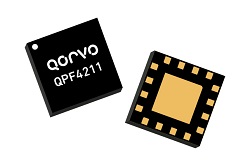
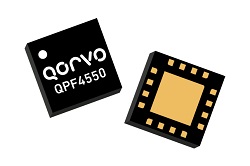
Qorvo offers FEM solutions that integrate power amplifiers, low-noise amplifiers, and transmit/receive switches into a single, compact package, reducing PCB area, weight, and power consumption. By simplifying layout and reducing tuning effort, FEMs accelerate the development of drone radios while ensuring reliable, high-performance RF operation.
 |  |
| QPF4211 | QPF4550 |
· Frequency Range: 2.412 – 2.484GHz · TX Gain: 33dB · Pout: 29.5dBm · RX Gain: 15dB · Supply Voltage: 5V · Size: 2.5 x 2.5mm | · Frequency Range: 5.15 – 5.855GHz · TX Gain: 30dB · Pout: 30dBm · RX Gain: 13.5dB · Supply Voltage: 5V · Size: 2.5 x 2.5mm |
Motor Control and RF Noise
Drone propulsion systems rely on high-speed motor drives, yet these same motors generate significant broadband RF noise that can disrupt sensitive onboard receivers. Without proper mitigation, this noise can degrade link performance, reduce navigation accuracy, and create instability in critical RF subsystems.
Engineers must address several key challenges to ensure reliable operation. EMI must be prevented from coupling into antennas and RF front ends, and harmonics generated across multiple frequency bands must be managed to avoid interference with onboard communication and navigation systems. Maintaining timing accuracy and preserving clean GNSS reception are also essential, requiring careful shielding, filtering, and grounding strategies. These considerations are central to maintaining system reliability and mission readiness in UAV platforms.
The Qorvo PAC5527 is a 48V BLDC Motor Controller and Driver with Charge Pump and Configurable AFE. Optimized for high-performance battery-powered BLDC motor control applications up to 24V, the PAC5527 integrates a high-memory FLASH-based 150MHz Arm® Cortex-M4F®, power management, high-side and low-side gate drivers and signal conditioning components in a single solution.
As a standalone 3-phase BLDC motor drive AFE, Qorvo’s ACT72350 is rated or up to 160 V, supporting drives up to 20S battery power. It powers the system MCU and provides ±2 A source/sink drive capability. Integrated bootstrap diodes and all necessary analog blocks for current sensing and protection reduce overall BOM.
Interconnect Solutions
Interconnect solutions are essential in UAV designs because they provide reliable high-speed links between sensors, processors, radios, and power systems, ensuring data and power move efficiently throughout the aircraft. They also improve durability and signal integrity in harsh vibration- and temperature-intensive flight environments, preventing performance loss or system failures.
The LM Series from Smiths Interconnect provides optical interconnects that protect signals from motor noise, RF interference, jamming, and other electronic warfare systems, making them immune to EMI and essential for defense drone applications. They support low-latency, Gbps-level throughput, enabling high-resolution video streaming. Lightweight, low-loss cabling improves payload efficiency and enhances security, as optical links do not radiate RF energy and are inherently difficult to jam.
The PE4545 from Pasternack is an SMA female right angle bulkhead connector that maintains 50Ω impedance for consistent RF signal integrity and supports compact SWaP-optimized layouts. Bulkhead mounting enables secure antenna or cable connections through the airframe while helping isolate sensitive RF paths from internal EMI sources such as motor controllers and power electronics. Robust materials provide reliable operation in high-vibration drone environments.
PE4545 Key Specifications:
- Frequency Range: DC – 12.4GHz
- VSWR: 1.23
- Impedance: 50W
- Interface Type: Thru-Hole PCB
Pasternack’s PE3C1843 is an SMA male to Mini-SMP right angle cable assembly supports dense RF module integration and simplifies routing in compact SWaP-optimized drone airframes while maintaining 50Ω impedance for consistent RF signal integrity. Double-shielded flexible coax helps mitigate EMI from motor drives and power electronics.
PE3C1843 Key Specifications:
- Frequency Range: DC – 18GHz
- Impedance: 50W
- Cable Type : PE-P086 flexible coax
- Shielding: Double-shielded
Programmable Frequency and Multi-Band Operation
Programmable frequency and multi-band operation allow drones to dynamically hop channels, avoid interference, and comply with global spectrum regulations. This capability supports flexible communication, adaptive telemetry, and resilient command and control links, especially in congested or contested environments.
Achieving fast and reliable PLL lock times is essential for rapid frequency switching, while minimizing phase noise across multiple bands ensures signal integrity. Antenna designs must support multi-band operation without compromising efficiency, and all components must meet regional and international regulatory requirements.
PLL Synthesizers
PLL synthesizers generate stable, tunable RF frequencies that serve as local oscillators for transmitters, receivers, and frequency conversion stages. Fast lock times, low phase noise, and fine frequency resolution are critical for frequency-agile UAV radios operating across multiple bands.
Qorvo’s RFFC5071A wideband LO generation enables multi-band drone radios with frequency agility for adaptive spectrum use. Integrated PLL, VCO, and high-linearity mixers reduce RF front-end component count, supporting compact SwaP-constrained platforms. The fractional-N synthesizer provides fine frequency resolution and low spurious performance, enabling flexible channel tuning for interference avoidance.
RFFC5071A Key Specifications:
- RF/IF Frequency Range: 30MHz – 6GHz
- LO Frequency Range: 85MHz – 4.2GHz
- Power Supply: 3V @ 125mA
- Size: 5 x 5mm
Oscillators
Oscillators provide precise timing and reference clock signals for RF transceivers, data converters, and digital processing systems in drones. Low phase noise, frequency stability, and vibration resilience are essential to maintain accurate communication, navigation, and radar performance during flight.
The SiT9356 series from SiTime features a differential MEMS design to deliver a low-jitter clock source for high-speed ADCs, DACs, and RF transceivers. Flexible differential output simplifies chipset interfacing and integrated power-supply noise filtering reduces external components for maximum signal communication link integrity.
SiT9356 Series Key Specifications:
- Frequency Options: 1 to 220MHz
- Frequency Stability: ±20ppm
- Min Supply Voltage: 1.8V
- Min Size: 0 x 1.6mm
Also from SiTime, the SiT7201 series solutions offer low phase noise performance that is well suited as a PLL reference clock in RF synthesizers, supporting low-error communication links. MEMS-based ruggedness and extremely low g-sensitivity reduce susceptibility to vibration-induced frequency variation, improving performance in drone flight environments.
SiT7201 Series Key Specifications:
- Frequency Options: 10 to 60MHz
- Frequency Stability: ±20ppb
- Phase Noise : -159dBc/Hz @ 10kHz
- Min Supply Voltage: 1.8V
- Min Size: 5.0 x 3.5mm
Drone Navigation Systems
High-end drones integrate radar, telemetry, and GNSS to achieve precise navigation and autonomous operation. Techniques such as RTK (Real-Time Kinematic) enhance positioning accuracy to the centimeter level, enabling applications such as swarm coordination, obstacle avoidance, and automated return-to-base functionality.
Antenna
Antennas convert electrical RF signals into radiated electromagnetic energy and vice versa, enabling drones to transmit and receive communication, navigation, and sensing signals. Key antenna characteristics for UAV platforms include gain, radiation pattern control, polarization, and compact aerodynamic form factors.
Pasternack’s PEANGPS1009 is an active GPS/GNSS antenna that supports reliable reception for drone navigation and positioning systems. Embedded low-noise amplification improves weak satellite signal acquisition, enabling accurate positioning for autonomous flight and RTK-enabled navigation. The compact low-profile design minimizes aerodynamic drag while rugged construction supports operation in demanding outdoor environments.
PEANGPS1009 Key Specifications:
- Frequency Range: 1559 – 1610MHz
- Gain: 10dBic
- Polarization: Linear
- Operating Voltage: 3.3V
- Size: 0.5 x 0.5 x 1.35in.
UWB and Radar
Ultra-wideband (UWB) radar provides automated obstacle detection to prevent crashes and supports real-time 3D positioning. By leveraging fixed UWB anchors on the ground, drones can achieve ±5 cm location accuracy and ±2° angular precision.
Drones can be localized even when hidden in vegetation after landing, enabling effective localization functionality. Real-time location data feeds flight control loops, compensating for wind drift and ensuring automated, stabilized flight. Accurate 3D positioning also enables coordinated drone operations with precise relative placement, as well as automated return-to-base procedures and safe indoor landings.
As a low power 6.5 & 8GHz SoC, Qorvo’s QM35825 integrates UWB, LNA, PA, and RF switches with digital back end. High-precision time-of-flight (ToF) and angle-of-arrival (AoA) processing maintain strong positioning margin for both rapid, low-altitude navigation and extended-range asset tracking in RF-dense deployments for autonomous drone navigation. UWB enables precise positioning in GPS limited environments also such as tunnels or indoors.
QM35825 Key Specifications:
- Frequency: 6.5 & 8GHz
- Ranging Accuracy: 5cm
- Angle of Arrival: 2°
- Voltage: 1.14 to 3.6V
- Size: 4.08 x 3.38mm
Conclusion
High-performance RF systems are the foundation of modern UAV capabilities, enabling resilient communications, precise navigation, and advanced autonomy. From multi-band radios and low-noise amplifiers to optical interconnects and UWB positioning, RF solutions ensure reliable operation in even the most demanding environments.
As a leading distributor of RF and microwave components, RFMW provides a comprehensive portfolio that includes advanced mission-critical solutions from best-in-class suppliers like Qorvo, Guerilla RF, Marki Microwave, SiTime, CML Micro, Smiths Interconnect, Knowles, Pasternack, Axiro, and many more that empower engineers to future-proof drone platforms.
RFMW empowers UAV developers to meet the demands of next-generation designs. Looking ahead, advances in mesh networking, onboard AI, and UWB-based positioning will expand autonomous capabilities, deliver centimeter-level accuracy, and enable precision flight control. Leveraging RFMW as a trusted distribution partner means that engineers can confidently design smarter, safer, more capable drones.
Technical Resources


RF Drones Frequently Asked Questions
What are key RF components in modern drones?
Modern drone designs rely on a wide variety of specialized RF components to maintain reliable communication, precise navigation, and advanced autonomy. Key components include, but are not limited to:
- Power Amplifiers
- Gain Block and Driver Amplifiers
- Low Noise Amplifiers (LNAs
- Telemetry/Video Links
- Lowpass and Bandpass Filters
- Satellite Links
- Mixers
- Filters
- Phased Array Solutions
- SDR-Based Drone Radios
- Balun
- Switches
- Front End Modules (FEMs)
- Programmable Frequency and Multi-Band Operation
- PLL Synthesizers
- Oscillators
- Antenna
- Radar
What are the key functions of drone operations?
The key functions of drone operation refer to the core technical capabilities a UAV must perform to fly safely and reliably, regardless of its end use. These functions form the foundation of all UAV performance and include:
- Command and Control (C2)
- Navigation and Positioning
- Communication and Telemetry
- Beamforming and Directional RF Management
- Motor Control
- Payload Management
What RF technologies are essential for reliable drone communication?
Reliable drone communication typically depends on multi-band radios, low-noise amplifiers, power amplifiers, front-end modules, and directional or beamforming antennas. These RF technologies work together to maintain stable command-and-control links, support high-throughput telemetry, and ensure robust connectivity in congested or interference-heavy environments.
How do drones avoid RF interference during flight?
Drones avoid interference using techniques such as frequency hopping, beamforming for directional links, strong frontend filtering, GNSS interference rejection, and real-time spectrum sensing. SDR-based radios can dynamically switch channels, helping drones maintain connectivity even when RF conditions change.
Why do drones need multi-band RF operation?
Multi-band operation allows drones to comply with regional regulations, switch frequencies to avoid interference, and use different bands for C2, telemetry, GNSS, and payload data. Multi-band radios also enable better spectral efficiency and improved coexistence in dense urban or industrial environments.
How does beamforming improve RF drone performance?
Beamforming electronically steers antenna patterns to focus energy toward a ground station or peer drone. This increases range, reduces interference, improves link robustness, and supports directional data links such as high-definition video downlinks or long-distance BVLOS missions.
How do SDRs benefit drone design?
Software-defined radios (SDRs) allow drones to switch waveforms, change modulation schemes, and hop between frequencies in real time. This improves spectral agility, supports global operation, and simplifies updates for new communication standards or mission requirements.
How can engineers prepare for next-generation drone design?
Engineers can leverage RFMW’s comprehensive portfolio of RF and microwave components from best-in-class suppliers for drone designs that maintain robust communication, precise navigation, and scalable autonomy for years to come.
References: