


A Word from Our Experts
Introduction on When Space Matters: QuarterSense in 0.5 TE Format by Colin Field, Business Unit Director at RFMW
When talking to engineers designing antennas for today’s connected industrial devices, I have heard firsthand how difficult it has become to balance competing priorities. As form factors shrink and devices are expected to support an expanding range of cellular and ISM bands, engineers are forced to contend with reduced volume, complex RF environments, and the performance limitations that follow. Nowhere is this more evident than in applications such as smart metering, where antennas must operate reliably inside dense metal enclosures while maintaining efficiency across challenging low-frequency bands. In my experience, achieving this level of performance requires more than incremental improvements. It calls for antenna solutions that are inherently wideband, space-efficient, and resilient to real-world deployment conditions.
Looking back over the past few decades, I have watched antenna design evolve alongside the broader wireless ecosystem, shifting from single-band, application-specific implementations to highly integrated, multi-standard platforms. As connectivity requirements have expanded to include LTE, LPWAN technologies, and short-range protocols, traditional approaches that treat the antenna as a discrete component have become increasingly inadequate. I believe the most effective solutions today are those that consider the antenna as part of a unified RF system, where mechanical, electrical, and electromagnetic design are tightly coupled from the outset. In this guest article, Quarterwave shares its perspective on this architectural shift and demonstrates how rethinking the role of the antenna can unlock greater flexibility and efficiency in space-constrained communication devices.
Colin Field, Business Unit Director at RFMW
When Space Matters: QuarterSense in 0.5 TE Format
Challenge
In antenna design bandwidth, efficiency, and size are inseparably linked. Shrink volume, add bands, or place antennas near metal, and performance drops, especially in low cellular bands like B20 or B8. Designing hardware that supports multiple regions and tech combos without redesigning antennas presents a major challenge.
Smart meters and industrial devices often utilize LTE, NB-IoT, LTE-M, Sub‑1 GHz, Wi-Fi, Bluetooth® Low Energy (LE), or ZigBee. However, when operating inside dense metal cabinets, currents shift, resonances move, and radiation efficiency suffers. In a 0.5TE housing, antennas quickly become the system’s limiting factor: minimal volume, unstable ground planes, and multi-antenna coupling add complexity.
Solution
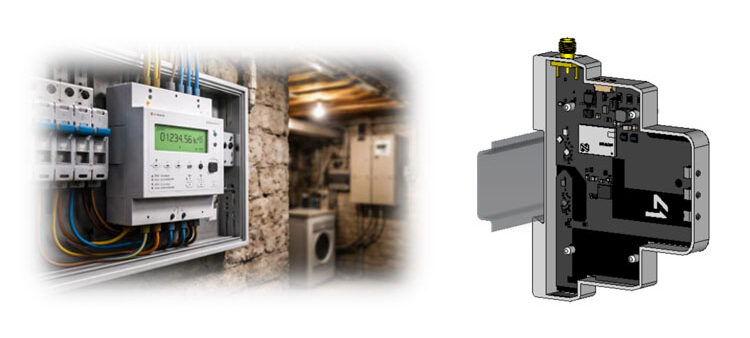
At Quarterwave, we didn’t just make the antenna smaller, we redefined its role. Instead of simply fitting into a device, QuarterSense (QW26-LTE/SM-1001) becomes the structural backbone of the Communication Unit, supporting the modem, RF-Front-end, and essential electronic components. The mechanical carrier and electromagnetic radiator merge into a fully integrated system. The traditional separation between “electronics” and “antenna” disappears: the antenna takes up no extra space in 0.5TE housing, it defines it. The PCB area is freed, power distribution is precisely controlled, and coupling paths are considered systemically from the start. This isn’t miniaturization by compromise, it’s miniaturization through architecture.
Enabling Accessible Wideband Performance
True wideband performance doesn’t come from simply adding multiple narrowband antennas, it comes from controlled electromagnetic structure design. QuarterSense is engineered as a multiresonant structure. Its careful geometric shaping and controlled current distribution excite multiple resonant modes that couple and overlap in a controlled way, producing continuous wideband behavior.
At lower frequencies, extended current paths and distributed loading concepts ensure sufficient electrical length despite limited mechanical size. At higher frequencies, defined higher-order modes are used strategically to expand bandwidth without introducing instabilities. The result is a single integrated antenna structure covering:
- Sub‑1 GHz cellular bands like B12, B13, B20, and B8.
- Higher LTE bands such as B1, B3, B4, B5, and B7
- ISM bands including 868 MHz and 915MHz ISM, 2.4 GHz ISM for Wi-Fi, Bluetooth LE, and ZigBee
- GNSS in the L‑band (optional)
Antenna in 0.5TE DIN-Rail Format
Engineered for Real-World Smart Meter Environments
In-real world environments, smart meters installations are typically mounted inside metallic enclosures, in close proximity to high-current and high-voltage components. Reflections, absorption, and field distortions are inevitable. Lower cellular bands are particularly sensitive in such environments. Many compact antennas suffer severe efficiency losses because the PCB unintentionally becomes part of the radiator and resonances shift unpredictably. By integrating antenna structure, mechanics, and electronics from the very beginning, these effects are not treated as afterthoughts — they are designed into the system. Current paths, grounding strategy, and radiator geometry are optimized as a unified whole. Instead of fighting the environment, the antenna architecture is engineered for it.
Performance Without Compromise: The QuarterSense in Action
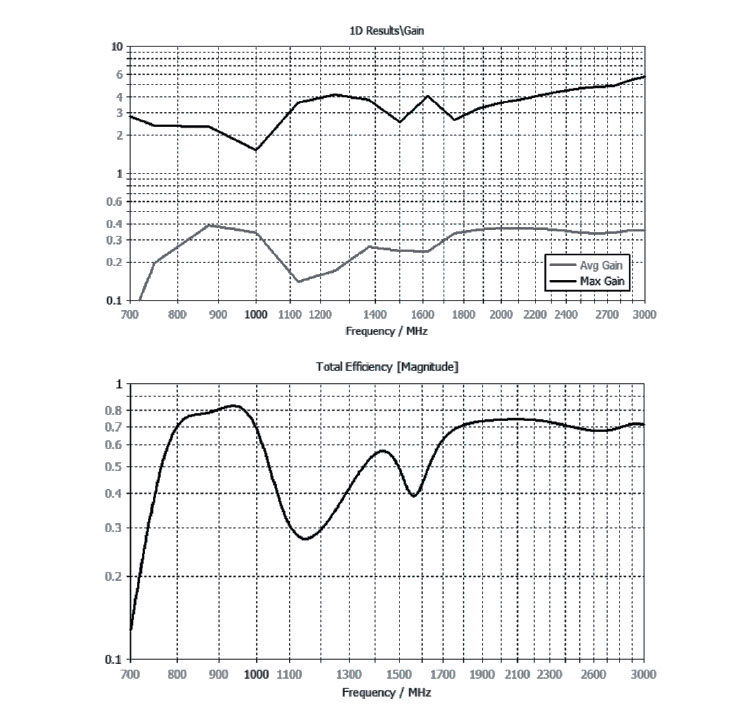
QuarterSense is more than a compact communication module. It is a flexible platform built for real smart-meter infrastructures. Its core application is receiving data via Wireless M-Bus and forwarding it securely to the cloud using NB-IoT or LTE-M. However, it is not limited to cellular connectivity. Depending on the operator’s requirements, data can also be transmitted via Wi-Fi, and even LoRaWAN® scenarios are technically feasible. The communication path is not defined by hardware constraints as it is defined by application. This flexibility is enabled by integrated wideband antenna architecture supporting Wireless M-Bus, NB-IoT, LTE-M, Wi-Fi, and the full range of LTE bands (including low bands such as B8, B12, B13, B20, and B28, as well as higher LTE bands up to 3 GHz and even L-band applications). High efficiency is maintained across the spectrum, including the particularly challenging Sub-1 GHz cellular bands.
QuarterSense can operate as a standalone smart meter or function as a compact gateway, aggregating Wireless M-Bus data from multiple meters and transmitting it to the cloud. An external SMA connector allows an optimized external antenna to be connected if needed. In demanding environments, the device can even serve purely as an antenna platform for other smart-meter systems. With a width of just 0.5TE, QuarterSense mounts directly onto the DIN rail without requiring additional cabinet space, adhesive antennas, or improvised magnetic solutions. It integrates seamlessly, delivering high performance, architectural efficiency, and maximum deployment flexibility in a single compact unit.
Conclusion
When antenna structure, mechanics, and electronics are engineered as one unified system from the start, even extreme space constraints can be pushed to their limits. The result is an LTE communication unit in a 0.5TE DIN-rail form factor supporting global cellular and ISM bands without external antennas or traditional integration compromises. At Quarterwave, antennas are not components. They are system-defining elements.