


RF & Microwave: Expanding Beyond Frequency
If you’ve spent your career in RF and microwave, as I have, 2025 reaffirmed something we’ve known for a long time: our world isn’t just creeping up in frequency; it’s expanding across applications. From terrestrial and satellite communications to defense systems (and yes, even Cornell University’s analog “microwave brain”) RF and microwave are now core infrastructure.
2025 Reality Check: What Didn’t Happen
The hype machine promised a lot. The market delivered…some of it.
- 5G Standalone (SA) stalled. Roughly 50 SA 5G networks were in service at the end of 2025, basically flat with 2023. Only about 15% of 5G deployments ran SA cores, meaning most operators still aren’t realizing the full benefits of network slicing or ultra-low latency in production settings.
- Consumer speed expectations vs. reality. Many users (me included) anticipated blistering speeds. Daily experience was mixed (sometimes slower than solid 4G LTE) because mmWave only shines in dense urban corridors, struggles indoors, and is expensive to deploy at scale.
This isn’t doom and gloom. It’s a sober read on the deployment curve.
What Did Happen: Big Moves That Matter
Progress turned up where the market needed it most.
- Non-terrestrial networks (NTN) became real. Few of us in 2015 would have bet on NTN rolling out at commercial scale by mid-decade. Yet here we are. Expect more in 2026 as Amazon’s LEO constellation (Project Kuiper) ramps. Europe’s AST SpaceMobile is targeting up to 500 spacecraft, and Eutelsat OneWeb, with 654 satellites in orbit, was first to deliver a 5G connection over LEO, the backbone for its IRIS2 constellation.
- Starlink closed the “digital divide” gap. Whatever you think of Elon Musk, Starlink solved a problem the U.S. government has poured tens of billions into: practical broadband in underserved areas. It isn’t cheap. It does work, and it covers nearly the globe.
Behind all of this are RF/microwave building blocks that used to be the exclusive domain of defense. Active electronically steered array (AESA) is now at home in commercial spacecraft, and RF inter-satellite links are moving beyond concepts into deployment.
AESA: The Standard for Next-Gen In-Flight Wi-Fi
AESA delivers:
- Faster beam steering
- Multi-orbit flexibility
- Lower latency and higher bandwidth
- Reduced size, weight, and maintenance
In 1967, the 15-year-old Joel (who hadn’t even flown on a plane before) would really appreciate the fact that he can pick any music at any time to be beamed down to him while flying 35,000 feet above the Atlantic Ocean. In 2025, the 73-year-old Joel gets really annoyed when he can’t email or post on Facebook when the airline’s Wi-Fi service sucks!
Back on Earth: FWA Changed the Broadband Narrative
Fixed wireless access (FWA) offered by Verizon (5G Home Internet), T-Mobile (Home Internet), and AT&T (Internet Air) has become one of the most disruptive forces in broadband.
- The top three carriers added 1 million new FWA subscribers in Q3 of last year alone, with a total U.S. FWA customer base of about 14.7 million.
DOCSIS Evolution: Coax Still Matters
Surprisingly, coax was a major contributor to RFMW’s growth last year. Why? Millions of installed cable systems and legacy distribution amplifiers still need upgrades and replacement.
- Modern DOCSIS 3.1 and 4.0 upgrades deliver 1–2 Gbps speeds today, with trials of multi-gig (up to 6 Gbps) over coax.
- These upgrades require only electronics swaps (modems, amplifiers), not new cabling. Coax is a practical choice for operators under pressure to boost speeds quickly.
- Hybrid Fiber-Coax (HFC) remains cost-effective for suburban and rural deployments.
- Many CATV systems still distribute RF video and broadband together. Coax supports both analog and digital signals, making it ideal for legacy TV + internet bundles.
Defense: Still the Engine Room of RF & Microwave
Defense spending and program momentum remain strong globally and continue to be an enormous driver of growth in the RF and microwave industry.
For perspective: if you invested $1,000 in Lockheed Martin in late 2022, you’d now be sitting on about $15,000 today, thanks to programs like the F-35. (This is commentary, not investment advice.)
As the U.S. is well behind on rejuvenating its stock of air defense systems and other major platforms, this trend is certain to continue for many, many years.
Quantum Technology: The Surprise of 2025
The most surprising development last year was the growth of quantum systems, from sensors to computing and communications.
Only a few years ago, it was a research project rather than a commercial application, but that’s no longer the case. Customers are now buying and building.
- At least a dozen microwave companies are already capitalizing on quantum applications, with components ranging from cables and connectors to switches and attenuators.
- Each cryostat can contain $1 million worth of RF and microwave technology, multiplied by hundreds of systems already in place.
- This market didn’t even exist less than a decade ago.
With fault-tolerant quantum systems still years away, it’s easy to see how this market will transform some sectors of our industry in the years ahead.

Looking Ahead: 5G, 6G, and Beyond
- 5G didn’t match media headlines, but it will advance in 2026. That puts pressure on GaN, InP, and SiGe to deliver more performance as systems push up to 80 GHz and beyond.
- 6G won’t arrive by 2030 as the boldest slides suggested, but when it does, expect near-zero latency and multi-gigabit (or higher) data rates. Achieving that means operating into terahertz (a leap, not a step).
Foundational R&D is already feeding practical innovations throughout RF/microwave components.
Cornell’s Microwave Brain
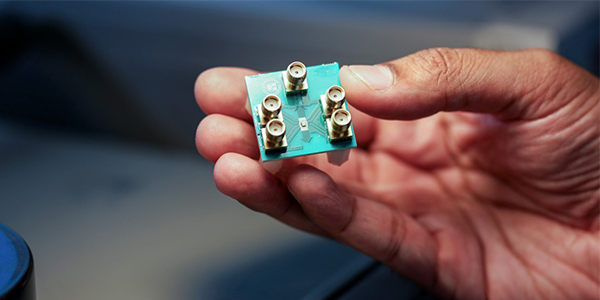
Researchers claim it’s the first microwave neural network implemented on a silicon chip, performing real-time frequency-domain computation directly on wireless and data signals, and consuming only 200 mW of DC power.
Their focus: signal decoding and radar target tracking. Unlike conventional neural nets, this approach leans into the analog nonlinear quirks of the microwave domain at around 10 GHz. It’s early and exciting.
Bottom Line for 2026
RF and microwave are no longer background plumbing. They’re the active, enabling layer for everything from NTN to FWA to quantum. The job now is to execute (design, qualify, ship, and support) with the same rigor we’ve always had, and with a wider horizon than ever before.