



The microwave signal chain within a dilution refrigerator is the backbone of superconducting quantum computing hardware. Achieving and maintaining signal integrity across temperature gradients from 300K to 10mK requires a detailed understanding of thermal conduction, electromagnetic propagation, and noise theory. Every cable, attenuator, filter, and amplifier must be optimized for thermal and electrical performance. As qubit technologies advance, the ability to engineer a stable, low-noise cryogenic environment is as important as the qubits themselves. Continued progress in this area will define the scalability, reliability, and efficiency of future quantum computing applications.
Developing these systems isn’t just technically complex; it also requires significant investment. Our RF experts collaborate with top suppliers who design components with scalability and upgradeability in mind. In this article, our team shares guidance on selecting the right RF products to support today’s quantum development while preparing for the rapid evolution of superconducting architectures.
Exploring RF Pathways in Quantum Systems
Microwave components are everywhere in quantum systems, at every level inside and outside the cryostat, from the highest to the lowest temperatures. They’re not hard to spot either: Just look at a quantum “chandelier” that sports dozens, even hundreds, of semi-rigid and flexible cables and connectors, each precisely tailored to the unique requirements of the system.
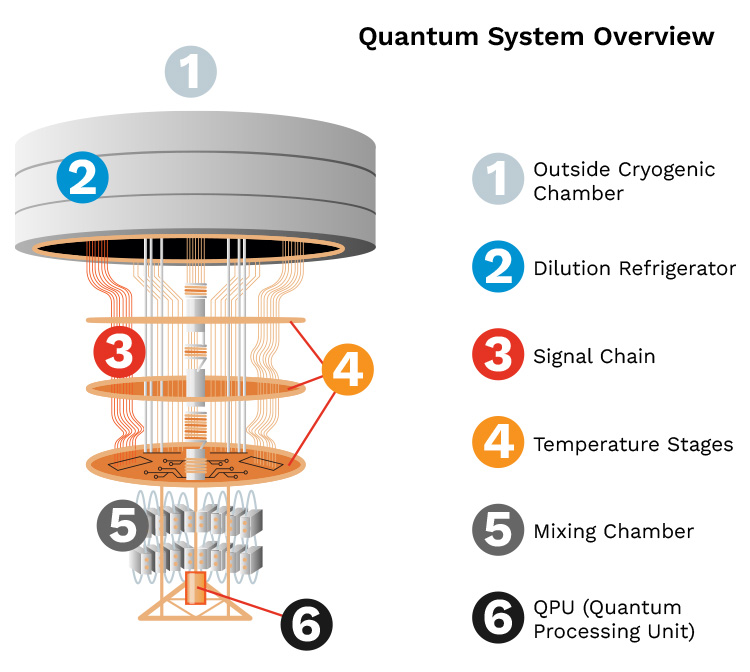
Quantum System Overview
- Room Temperature – Outside Cryogenic Chamber: Outside the cryostat, critical RF components like mixers and synthesizers generate, route, and condition signals for qubit control and readout. These systems require exceptional noise performance and precision to maintain coherence and enable accurate quantum operations.
- Dilution Refrigerator: During operation, the system is enclosed in multiple nested shields. These layers serve as both thermal and radiation barriers, maintaining cryogenic temperatures and preserving the vacuum environment.
- Signal Chain: Microwave signals travel through these cables to control qubit operations and carry measurement data back from the chip.
- Temperature Stages: Gold-plated copper plates divide the cryostat into thermal zones, each stage colder than the last, reaching temperatures near 10 millikelvin at the bottom.
- Mixing Chamber: This ultra-cold stage hosts the most sensitive components: amplifiers, filters, cabling, and the mounts that support the quantum processor itself.
- QPU (quantum processing unit): The quantum processing unit is a superconducting integrated circuit housed in a metal package that provides thermal anchoring and environmental shielding, forming the core of the quantum computer.
Following the Signal Chain from Room Temperature to Millikelvin
Superconducting quantum processors depend on accurately manipulating qubit states using microwave control signals. These signals originate from room-temperature electronics, operating near 300K, and must propagate through a series of thermal stages down to the quantum processor at the bottom of the dilution refrigerator, where temperatures reach 10 to 15 mK.
The uppermost flange remains at ambient temperature and steps down through ~50K, 4K, 700mK (the still), 100mK (the cold plate), and finally the mixing chamber near 10mK (or below). Each stage provides mechanical support, thermal anchoring for components, and interfaces for microwave transmission lines.
Room Temperature
At the top of the signal chain, vector signal generators and arbitrary waveform generators create control pulses with nanosecond timing resolution. Typically ranging from 4 to 8 GHz, these signals are modulated with precise amplitude and phase profiles to implement single- and two-qubit gates. The quality of these pulses determines the qubit’s gate fidelity, so phase noise and harmonic distortion must be minimized.
Before entering the cryostat, the signals pass through conditioning stages, which may include bandpass or low-pass filters to suppress spurious spectral components and fixed attenuators that establish an appropriate drive level. The signals then enter semi-rigid stainless steel coaxial cables that descend to the 50K stage. Stainless steel is chosen for its low thermal conductivity compared to copper, despite its higher insertion loss. The objective in this upper section is not signal performance but the reduction of heat conduction into the cryostat.
The 50K Stage
At the 50K stage, attenuation is applied to suppress room-temperature Johnson noise propagating toward the qubits. Cryogenic attenuators at this stage typically provide 10 to 20 dB of loss using resistive films such as nichrome or tantalum nitride. These devices maintain nearly constant resistance values as temperature decreases, enabling predictable attenuation.
The 4K Stage
The next stage at 4K (absolute zero) is 0K (-273 C), the lowest temperature at which all particle motion theoretically stops. Cooling power here is high, allowing the use of more conductive materials such as copper or superconducting niobium-titanium (NbTi) lines. The goal at this point is to reduce signal loss while continuing to suppress noise. Cryogenic attenuators ranging from 10 to 20 dB and cryogenic low noise amplifiers are often installed at this level.
Sub-Kelvin
Below 4K, thermal budget becomes increasingly constrained. The still stage operates near 700mK and the cold plate near 100mK. At these levels, cable materials are typically made of NbTi or copper-nickel (CuNi) alloys, which offer lower thermal conductivity. NbTi becomes superconducting at around 9K, eliminating DC resistance and significantly reducing loss. CuNi cables, though not superconducting, provide a good compromise between electrical loss and thermal isolation.
Design Priorities in Cryogenic Architectures
Non-Magnetic Components
Non-magnetic microwave components are essential in quantum systems, particularly superconducting qubits that are extremely sensitive to magnetic fields. Even small, uncontrolled magnetic fields from nearby materials can interfere with qubit coherence and cause decoherence, which degrades the quantum information stored in the qubits. Stray magnetic fields from components can also shift qubit frequencies, making it difficult to perform precise quantum gate operations.
Magnetic materials can also generate flux noise that couples to the qubits and introduces errors. In the tightly controlled environment required for quantum computing, where qubits must maintain their quantum states for as long as possible, any source of magnetic interference is detrimental. This is especially critical at cryogenic temperatures, as magnetic properties of materials can change with temperature and potentially introduce interference.
Low Noise Figures
Quantum systems are extremely sensitive to noise. Quantum states can be disrupted by even minor disturbances. In superconducting or trapped-ion qubits, coherence—the ability of a quantum state to maintain a well-defined phase relationship over time—is essential for performing reliable quantum logic operations. Thermal noise, electromagnetic interference, and amplifier-generated noise all introduce random fluctuations that cause decoherence, effectively destroying the quantum information stored in the system.
Maintaining extremely low noise levels requires operating qubits at millikelvin temperatures, where thermal photon populations are minimal, which makes microwave signal chains that suppress noise essential. Any residual noise that reaches the qubit can alter its energy state or phase, leading to computational errors and reduced gate fidelity. This becomes even more important as the system scales because quantum algorithms rely on coherent superposition and entanglement, so small increases in noise scale with system size.
Thermal Stability
Maintaining very low noise levels requires operating at millikelvin temperatures, where photon populations are minimal. Microwave signal chains must be designed to suppress noise at every stage because any residual noise that reaches the qubit can alter its phase. As quantum processors scale to a larger number of qubits, even small increases in noise become more harmful because algorithms rely on coherent superposition and long-range entanglement.
Each additional qubit requiring multiple microwave lines increases thermal load and mechanical complexity. For systems targeting hundreds of qubits, the routing of coaxial cables and thermal anchoring of components occupy most of the refrigerator volume, making integration density a limiting factor. Emerging solutions include cryogenic multiplexing, superconducting integrated microwave circuits, and photonic interconnects. These approaches aim to reduce the number of physical cables while maintaining low-noise operation. However, if coaxial signal chains remain the dominant architecture, precise engineering of the microwave environment will remain critical to quantum processor performance.
Low Insertion Loss
Low insertion loss is essential for maintaining signal strength from room temperature to millikelvin temperatures. Readout signals are extremely weak, and even modest loss can severely impact qubit fidelity.
Qubit readout involves sending a microwave probe signal into the qubit’s resonator and detecting its phase or amplitude shift, which encodes the qubit state. These reflected or transmitted signals are typically in the femtowatt range, corresponding to a few hundred photons. Amplifying them while preserving phase information and minimizing added noise poses a significant challenge.
Readout Chain Behavior at Cryogenic Temperatures
The first amplification stage uses a Josephson parametric amplifier at the mixing chamber. These devices exploit the nonlinear inductance of Josephson junctions to achieve gain with noise performance approaching the quantum limit, adding less than one photon of noise at the signal frequency. Depending on circuit topology, the amplifiers are operated in reflection or transmission configurations, and their gain is stabilized through magnetic flux bias control.
A cryogenic circulator or isolator immediately follows the first amplifier to prevent back-propagating noise from higher temperature stages. These components use ferrite materials biased by static magnetic fields to enforce unidirectional transmission. The insertion loss is typically 0.3 dB, and isolation exceeds 20 dB.
The next amplification stage is located at the 4K plate, and while not quantum-limited, it establishes a signal-to-noise ratio high enough for subsequent room-temperature amplification. Intermediate isolators are sometimes installed between the mixing chamber and 4K stage to suppress reverse noise propagation further.
After the 4K amplifier, the readout signal passes through stainless steel or CuNi coaxial cables up to room temperature. Additional amplifiers at the cryostat’s top flange may add 20 to 30 dB of gain. The final room-temperature electronics include further amplification, IQ downconversion using mixers, and high-speed analog-to-digital conversion. Subsequent digital signal processing extracts qubit states, performs integration of the readout waveforms, and applies real-time feedback or error correction.
Overcoming RF Quantum Challenges with Cryogenic-Qualified Solutions Now Available at RFMW
Quantum platform design requires an inherent holistic perspective. Every component in the RF signal chain influences system performance, and even small misalignments can impact the broader architecture. For example, a minor increase in insertion loss can elevate noise figures, weaken signal integrity, and lower qubit fidelity.
RFMW is uniquely positioned as a one-stop solutions provider for tackling the wide range of design challenges in developing quantum systems. From comprehensive thermal management solutions to material compatibility and packaging/density constraints, our offering is purpose-built to help developers achieve their engineering goals. Our technical expertise, broad portfolio of best-in-class RF and microwave solutions, and design support enable you to confidently meet RF quantum design challenges head on.
Partnering with RFMW as a trusted distributor is a distinct advantage in a sector with complex logistics and extremely specific hardware requirements. By delivering cryogenic-ready components along with engineering insight and supply-chain support, RFMW helps customers build quantum architectures that are stable, scalable, and aligned with long-term system performance goals.
The following are examples of some of the RF components used within Quantum systems and their function and placement within the system.
IQ Mixers
Placement: Outside the Cryogenic Chamber
While the majority of the quantum system is housed inside a cryogenic chamber, the control and readout electronics sit outside the fridge at room temperature. Microwave IQ mixers generate the shaped microwave pulses used for qubit control by vector-modulating a local oscillator with I and Q baseband signals. This enables precise control of pulse amplitude, phase, and envelope for accurate implementation of quantum gates. The mixer upconverts baseband waveforms to the microwave frequencies at which qubits operate and downconverts readout signals back to baseband while preserving amplitude and phase information for state measurement. To maintain signal integrity, these mixers must offer low conversion loss, excellent linearity, minimal spurious products, and high port isolation. Although qubits reside inside a cryogenic environment, the IQ mixer operates at room temperature and must deliver clean, spectrally pure signals into the cryostat to ensure reliable qubit performance.
Leveraging more than three decades of RF and microwave innovation, Marki Microwave is a leader in high-performance components for mission-critical and advanced research applications. The MMIQ-0218 IQ Mixer delivers exceptional amplitude and phase balance, enabling precise vector modulation and demodulation for high-fidelity quantum control and readout systems.
With ultra broadband coverage from 2 to 18 GHz, the MMIQ-0218 supports the critical 4 to 8 GHz qubit band while providing additional frequency headroom to accommodate evolving and future quantum architectures. As a passive GaAs MMIC mixer with an integrated on-chip LO quadrature hybrid, it delivers up to 40 dB of image rejection for excellent phase and amplitude balance. While the MMIQ-0218LXPC connectorized module has been proven in quantum research labs, the MMIQ-0218 is also available as a bare die and 6 mm QFN package, enabling a seamless transition from connectorized prototyping to production-scale quantum systems.
Featured Products:
Ultra-Low-Noise Amplifiers (LNAs)
Placement: Inside the Cryogenic Chamber
Cryogenic LNAs are designed with ultra-low noise as a primary objective. Qubits must operate at millikelvin temperatures, where thermal photon populations are minimal; any added noise in the microwave signal chain can alter its energy state or phase, leading to computational errors and reduced gate fidelity. As the system scales, this challenge becomes even more critical as quantum algorithms rely on coherent superposition and entanglement, so even small increases in noise accumulate with system size.
With a broad portfolio spanning RF and microwave, spaceborne, and SATCOM, Narda-MITEQ has a comprehensive set of cryogenic amplifier solutions that meet the thermal, mechanical, and electromagnetic requirements of quantum environments. Their CLNA Series features a fully non-magnetic LNA architecture optimized for ultra-low noise performance and low DC power consumption. Operational down to 4K, CLNA solutions are RoHS compliant with RF ports matched to 50 OHMs
Featured Products
- CLNA-30-0400-0800-5P-ND
- CLNA-30-0400-1200-5P-ND
- CLNA-40-0500-1000-5P-ND
- CLNA-40-0500-1000-5P
- CLNA-30-0500-1000-5P
- CLNA-30-0500-1000-5P-ND
- CLNA-25-0500-1000-5P-ND
- CLNA-25-0500-1000-5P
- CLNA-30-0800-1200-5P-ND
Flexible Cable Assemblies
Placement: Inside the Cryogenic Chamber
There are many attenuators in a quantum system, including those integrated within the cables themselves. XMA Corporation specializes in a wide range of solutions for military, aerospace, test and measurement, medical, and telecommunications equipment application. Their approach to bulkhead attenuators offers clear advantages over standard body attenuators with adapters. For example, bulkhead attenuators reduce the number of connections in the signal path, which minimizes insertion loss and impedance mismatches while eliminating unnecessary materials. Additionally, mounting directly into the cryostat plate shortens the heat path, improving thermal conduction and dissipation compared to conventional setups that route heat through multiple interfaces.
To support higher density architectures, XMA’s attenuator blocks can have up to 24 ports with their SMPM connectors mounted to the plate, which can fit many more signals into a given form factor. Their 4880-5523-dB-CRYO bulkhead attenuator is made from gold-plated copper, provides attenuation up to 30 dB, operates to 18 GHz using 2.92 mm connectors, and is engineered specifically for cryogenic and quantum system environments.
Featured Products
- 4880-5523-02-CRYO
- 4880-5523-30-CRYO
- 4880-5523-20-CRYO
- 4880-5523-10-CRYO
- 4880-5523-06-CRYO
- 4880-5523-03-CRYO
- 4880-5523-01-CRYO
- 4880-5523-00-CRYO
- Cryogenic Flex Cable + supporting components (flange, attenuators)
Precision RF Interconnects
Placement: Inside the Cryogenic Chamber
RF interconnect components in quantum computing systems are foundational elements of overall architecture. Signal integrity must be maintained through extreme cryogenic conditions, across multiple thermal stages, and into the quantum processor itself—where even minimal loss, reflection, or magnetic interference can compromise fragile qubit states. From non-magnetic connectors to superconducting cable assemblies, every interconnect must be engineered for precision and reliability.
Rosenberger has one of the most comprehensive portfolios of products designed for quantum systems. Their new multichannel WSMP-based connectors significantly increase microwave transmission line density within a fixed footprint, with some models including integrated ceramic attenuators. With a frequency range up to 67 GHz, these future proof connectors are available with either 16- and 32-channel configurations. Rosenberger also supplies UT-047 semi-rigid cable assemblies in materials such as stainless steel, CuNi, niobium-titanium, and beryllium-copper to meet diverse cryogenic and mechanical constraints.
Their patented AuroDur® plating combines a 0.15-µm gold layer with a two-to-three-micrometer non-magnetic nickel underlayer to provide excellent electrical, mechanical, and environmental performance. The chemically deposited nickel prevents metal diffusion and magnetic interference, while the gold surface ensures low contact resistance, corrosion protection, and stable RF performance.
Rosenberger also enables high-density routing through compact connector systems with 2.5-millimeter pitch, supporting space-constrained cryostat-stages. Blind-mate interfaces such as WSMP and SMPX simplify assembly in confined, thermally isolated environments. They provide flexible standard and custom options by adapting proven RF channels into application-specific housings without the cost or lead time of full-custom development.
With vertical integration that reinforces custom capabilities, Rosenberger’s in-house machining and advanced lithographic techniques support micron-level tolerances required for next-generation quantum hardware. Rosenberger’s ongoing research initiatives, including contributions to qBriqs and qSolid, further extend their focus on dense, low-loss, cryogenically stable interconnects.
Explore Rosenberger’s portfolio here: ST_Quantum_Technologies_Flyer_2025.pdf
Read more about Rosenberger in our Supplier Spotlight.
Featured Products
- Cryogenic Interconnects
RF Switch Solutions
Placement: Inside and Outside of the Cryostat
Cryogenic microwave switches route signals between different quantum chips or test configurations. Their electrical design requires maintaining less than 0.5 dB of insertion loss and greater than 40 dB of isolation while minimizing the switch’s power dissipation. Latching configurations are often preferred because they do not require continuous drive current, effectively reducing thermal load.
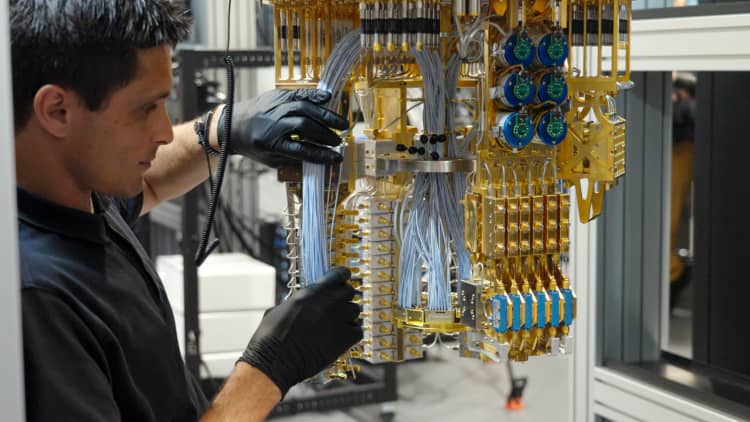
Radiall has emerged as a key enabler of quantum computing hardware by solving some of the industry’s most difficult RF and mechanical challenges inside cryogenic environments. While most microwave switches are used outside of the cryostat, Radiall’s R583423141 RAMSES™ SP6T cryogenic switches are one of the first to operate within it. These switches operate to near absolute zero and switch in less than 15 ms. They also have an impressive MTBF of about a million cycles per position, even at their lowest operating temperatures.
Traditional switches move a rectangular contact reed inside a cavity, which is linked to dielectric “transmission pushers” directed by insulated guides. However, during the switching sequences, these dielectric parts rub against the reeds and transmission holes, generating insulating particles in the RF cavity that pollute the contacts. This typically results in defects and an increase in insertion force. In contrast, RAMSES switches have parallel spring blades suspended from a barrier outside the RF body to eliminate this problem. These blades create a rectilinear motion on the pusher, suppressing friction and particle production inside and outside the RF cavity.
Read more about Radiall in our Supplier Spotlight.
Featured Products
How to Design for Future Cryogenic RF Systems
Looking ahead, quantum labs are rapidly expanding, and system architectures are shifting toward larger qubit counts, higher integration density, and more complex control electronics. Trends like cryogenic multiplexing, integrated microwave modules, and custom low-temperature packaging will play an increasingly important role.
As quantum adoption accelerates, each new architecture presents its own set of design challenges: lower noise, tighter phase, stability, higher isolation, and greater signal integrity. These demands become even more complex within the cryogenic environments where most quantum hardware operates. Components must deliver consistent, predictable performance across extreme thermal gradients, spanning from room temperature down to millikelvin.
As a trusted distributor specializing in RF and microwave components, RFMW combines in-house engineering expertise, a comprehensive portfolio of cryo-qualified RF quantum solutions from leading suppliers, and a robust library of technical resources. As demands intensify, we are committed to helping navigate cryogenic constraints, evaluate performance trade-offs, and confidently source the solutions for next-generation quantum systems.
With design consultation, application engineering support, and an industry-leading selection of cryo-qualified RF components, RFMW helps accelerate development and reduce risk in environments where performance margins are tight and component volumes are often low. By combining technical insight with dependable supply-chain access, RFMW enables engineers to adopt future-ready architectures with confidence
Frequently Asked Questions
What does RF Quantum Mean?
RF quantum refers to the use of radio frequency and microwave signals to control, read out, and interface with quantum devices like superconducting qubits. These signals form the communication layer that lets classical electronics interact with quantum hardware. In practice, RF quantum systems are built around a microwave signal chain that operates across extreme temperature gradients inside a dilution refrigerator.
Why are RF components critical in quantum computing systems?
RF components are critical to quantum computing systems because quantum processors rely on precisely shaped, ultra-low noise microwave tones to manipulate qubit states and measure their responses. Every component in the signal chain influences RF signal integrity, noise levels, and timing accuracy. Even minor changes in insertion loss or phase stability can alter qubit coherence and readout fidelity. Since superconducting circuits operate in a regime where small perturbations can disrupt quantum behavior, well engineered RF components are essential to maintain reliable quantum operations.
Why do quantum systems require cryogenic-qualified RF components?
Superconducting qubits and other quantum device fabrication approaches require temperatures near 10mK. At these extremes, materials contract, dielectric properties shift, and thermal loads must be rigorously managed. Cryogenic qualified components are designed with advanced material science and thermal management solutions that ensure stable RF performance across temperature transitions from 300K down to millikelvin levels. Without them, noise increases, signal levels drift, and the entire quantum computing stack becomes less reliable.
Which RF components are located inside and outside the cryogenic chamber?
RF Components Inside the cryogenic chamber:
• Cryogenic attenuators and filters
• Low noise amplifiers for cryogenic measurement systems
• Isolators and circulators to protect qubits
• Low thermal conductivity coaxial cables
• Cryogenic switches and couplers
RF Components Outside the cryogenic chamber:
• Microwave generators and modulators
• IQ mixers and DAC based pulse shaping hardware
• Room temperature LNAs
• Control electronics and timing sources
• Additional microwave signal processing and routing hardware
How does low noise impact qubit fidelity?
In quantum systems low noise impacts qubit fidelity because even small amounts of added noise can disturb fragile qubit states and disrupt quantum entanglement communication. Low noise operation improves state discrimination, gate fidelity, coherence times, and overall system reliability. Since readout is performed using extremely weak microwave returns, noise directly affects measurement accuracy and the long term scalability of quantum processors.
Why is insertion loss a key design consideration in cryogenic RF systems?
Insertion loss reduces available signal power, increases effective noise temperature, and generates heat that must be removed by the cryostat. In low temperature electronics, every milliwatt of thermal load matters. Loss also degrades RF signal integrity and can impair readout fidelity in cryogenic measurement systems. Minimizing loss is essential for maintaining high accuracy, stable qubit control, and efficient thermal management solutions inside the dilution refrigerator.
How to put RF into a Quantum actuator
A quantum actuator uses calibrated microwave pulses to drive transitions in superconducting qubits. RF engineers generate these pulses at room temperature, shape them using microwave signal processing hardware, and guide them through a cryogenic RF chain optimized for thermal management and low insertion loss. Inside the cryostat, attenuators, filters, and superconducting interconnects ensure that the final signal arriving at the qubit has the correct amplitude, phase, and timing. This careful integration of RF design and quantum device fabrication enables precise qubit control.
How does RFMW support quantum system designers?
RFMW provides a one stop resource for cryogenic qualified RF components that support quantum computing applications, superconducting circuits, and advanced quantum research. Engineers can tap into technical insight, application support, and inventory access for components specifically engineered for low temperature environments. RFMW helps designers balance RF signal integrity, thermal management, insertion loss budgeting, and material compatibility. Whether the need is components for cryogenic measurement systems, microwave signal processing, or quantum actuator design, RFMW delivers the expertise and solutions required to accelerate innovation in the quantum sector.