


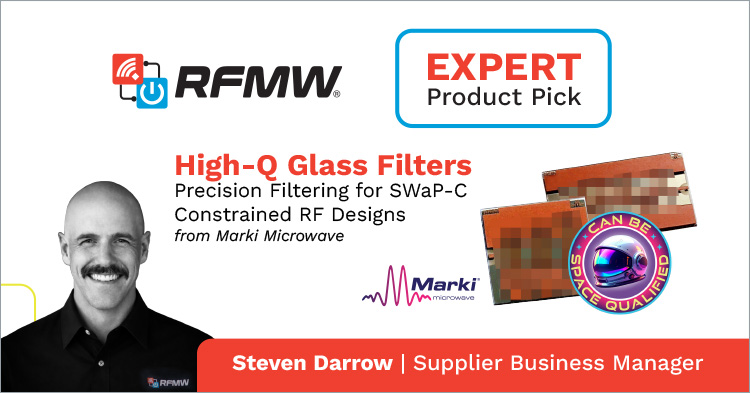
What made you select the Marki Microwave High-Q Glass Filters?
I chose the Marki Microwave High-Q Glass Filters because they give RF designers a way to achieve high-selectivity filtering in the MHz to low-GHz range without the size and performance compromises that often come with other competing technologies. This combination is particularly valuable for IF signal conditioning and anti-aliasing applications, where sharp rejection near the passband is often required while keeping insertion loss low and maintaining a tight SWaP-C budget. These requirements become even more important in space and satellite systems, where every square millimeter of board space matters. In these environments, size, weight, power handling, and long-term reliability are critical design considerations, making compact, highly integrated filtering solutions especially attractive.
Another thing that stands out is how Marki applies its precision glass substrate technology to frequency ranges where designers have traditionally relied on discrete LC or ceramic filter solutions. At VHF through C-Band frequencies, achieving the required filter selectivity can quickly increase component count, PCB area, and overall design complexity. Parasitics and component tolerances can also make it more difficult to reproduce simulated performance in production hardware. Marki’s glass process enables compact, tightly controlled filter structures with strong unit-to-unit consistency. As a result, designers can take advantage of supplied S-parameter models during development with greater confidence that measured results will closely align with simulation predictions.
The family includes lowpass, highpass, and bandpass configurations, with lowpass and highpass devices in packages around 4.25 × 4 mm and bandpass devices as small as 7.5 × 4.25 mm. Depending on the model, coverage extends from the hundreds of megahertz into C-Band, with power handling up to 15W CW. Examples include a 430 to 990 MHz bandpass filter with approximately 0.9 dB center-frequency insertion loss (MFBP-00164GSM1), as well as lowpass filters with cutoff frequencies extending to 4.9 GHz (MFLP-00045GSM2). The family gives designers plenty of options for achieving higher rejection without consuming valuable board space, making it especially attractive for SWaP-C-sensitive and space-focused RF programs.
What are the key features and specifications of the Glass Filters?
Key Features include:
- High-Q glass substrate technology
- High rejection with low insertion loss
- Compact SMT packages for SWaP-C-constrained designs
- Lowpass, highpass, and bandpass options
- Up to 15W CW power handling
- Ready for space qualification
What are the common markets and applications of these High-Q Glass Filters?
They are ideal for the following markets/applications:
- IF Signal Conditioning
- Anti-Aliasing Filters
- Satellite & Spaceborne RF Systems
- Communications Systems
- Radar Systems
Other Marki Microwave Expert Product Picks from Steven Darrow
Marki Microwave’s MPD4-0218CSP3 4-Way Wilkinson Power Divider/Splitter
Marki Microwave’s MPD4-0422CSP2
Marki Microwave’s ADM-8536PSM 2-20 GHz High Linearity LNA
Marki Microwave’s MFBC-0000XPSM Family
Marki Microwave’s HLM-40PSM Limiter